10 days as a silent monk

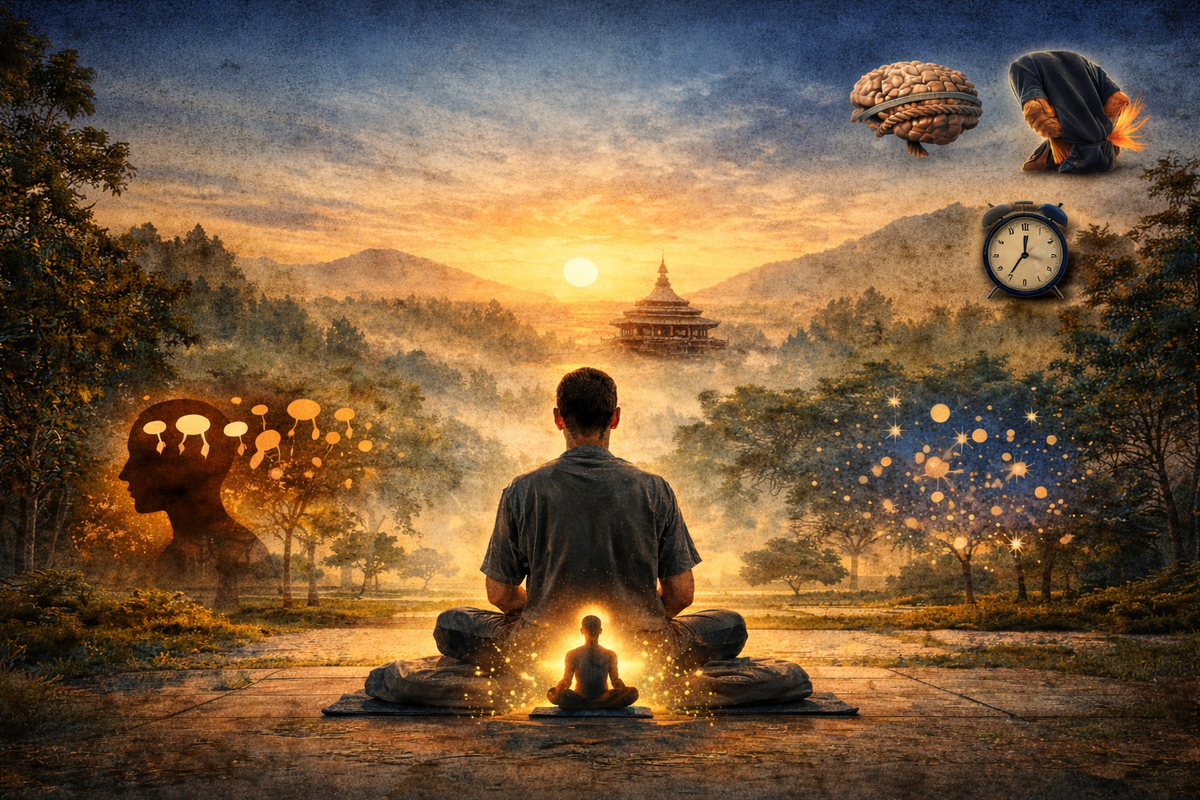
This week I return from a 10 day Vipassana mediation retreat.
It's a 10 day silence retreat where you renounce to all your possessions except clothes and hygiene products. No talking, no reading, no listening to music are allowed, and not even looking at other participants directly, least one tries to communicate by signs! But food and lodging are provided for free so the environment is perfectly controlled to do one and only one thing: meditate.
A lot goes through one's head during these 10 days, and here are my impressions just a few days after leaving the retreat, to try to explain to those who haven't done it.
Isn't it hard?
I know this is your first question. I'm not gonna lie, it is tough mentally and physically.
Mentally, one realises how much your mind tries to sabotage you. It kicks, screams, cries, cajoles, tries to convince you that there is a legitimate excuse to abandon... it has a complete aversion to hard things. I ended up cherishing sleep time because it's the only time one can escape the mind, together with meditation time.
Physically, sitting for so many hours (officially 8, but during individual meditation hours one can move a bit) is tough and back starts to hurt, legs start to hurt... but then one realises how much of it is mental. I got to experience first hand the buddhist adage of "Pain is inevitable, suffering isn't".
What happens in there?
In short, you wake up at 4 in the morning and have a full schedule of meditation with meal breaks and some recess to wash yourself, walk around the property and do laundry. There are video recordings of S.N. Goenka explaining the philosophy of Dhamma and 3 group meditations per day that also include specific instructions, which is how you learn the meditation techniques that are taught: Anapana, Vipassana and Mehta.
With so many hours spent in the meditation cushion, what ends up happening there is that you'll try to focus on the meditation technique and thoughts will pop up in your mind. You are to not react (remain equanimous) and go back to practising the technique. This slowly clears your mind of these thoughts that you learn to ignore.
I haven't quite understood what is the mechanism that, after clearing your mind of some of the immediate superficial worries, brings powerful memories from the past afloat. Some get memories from childhood. Some get flooded by craving and taken over by rumination and expectation. Eventually, traumas from the past will arise.
No matter what comes, the whole point is to always remain equanimous - that is: to not react to whatever is happening. This applies to physical sensations, which can be pleasurable or painful, and also thoughts and emotions that come up.
The body-mind connection
How do physical and emotional sensations relate and why by focusing on the body we can also overcome emotional sensations? Every thought will generate a bodily reaction before one can start rationalising and finding out whether one likes it (might end up generating craving) or doesn't (might end up generating aversion). Therefore, by observing the body and its sensations and remaining equanimous we are training for when this happens with thoughts too: the connection is the physical sensation.
This is the second mechanism that I don't quite understand either: does every mental process start with a bodily sensation? My experience during the meditation is that I was only able to detect a bodily sensation right after the thoughts that were able to disturb me considerably, but it might be that my mind isn't sharp enough to detect subtler experiences.
Equanimity as the only sensible response to everything
You are told that one must remain equanimous to both feelings of craving and feelings of aversion. But how is remaining equanimous helping?
Firstly, by not reacting, not engaging with discourse of the likes "oh my god, I'm in so much pain, my leg is going to explode" and focusing on the object of meditation - the breath, the sensations on the area above the upper lip and below the nostrils (anapana), the sensations in the body (vipassana), the suffering diminishes or is eliminated entirely. One can still feel the pain, but stops suffering from it and might even forget it or the painful sensation might disappear.
Emotionally, we also engage in discourse about the thoughts that inevitably come up: positive and negative.
For positive thoughts it could be: a thought of seeing a friend pops up and we start discoursing: "Oh how I wish I would be out of here, I want to see my friends, do this, do that..." and by engaging in this inner discourse, more suffering is created - suffering for the fact of not achieving what one desires. This is framed as "craving" in the Vipassana teachings.
For negative ones, it could be a negative memory, image or sound that pops up and one starts thinking: "Again this happened to me, why is it so annoying? I am ever going to achieve what I want? What if I am not good enough to achieve anything I want?" and we generate suffering for it too.
So by remaining equanimous and reminding ourselves it's all temporary, we don't give the mind the opportunity to generate that suffering.
The mystical experience of meditation (... not)
There are no "illuminations", huge mystical experiences, but I did get to understand at the experiential level something that everyone is able to understand intellectually: we are really just a bunch of atoms in the universe that in a cosmic instant, will reconfigure into something else.
Some of these atoms that are now part of "me" will be part of a future tree, some of them will be in the ocean and some of them in page two of an underground clandestine Indonesian fanzine stamped with political messages against a future tyrannical emperor of South East Asia.
Then... why the fighting? Why the war? Why the misery? It all starts seeming so pointless. From this it follows that if we are just this configuration of atoms and everything else is exactly the same, why not make things nicer for them too? Why not extend the love and compassion for our limited set of atoms to all the atoms? The "I" seems like a silly temporary concept, and a willingness to work to better the world beyond the arbitrary boundary of "I" starts appearing.
What's the point of doing such a course?
Of course the first order purpose is to actually learn the technique of Vipassana meditation, but why would anyone do such a thing? After the fact, I think one would do it for two main things:
- The end goal of Vipassana is stated as "full liberation", which is to eliminate suffering. This is of course not achievable in a 10 days course and almost impossible even after an entire lifetime. But by learning firsthand that all is temporary and remaining equanimous, one can stop a lot of the mental patterns that bring us to suffering. Again, bad times will come and so will good times, but craving or fearing one or the other is what generates misery for ourselves. If we can reduce the generation of this misery by whatever percentage, it's already a life better lived.
- Personally, I also went to train my mind to be sharper. The ability to concentrate deeply, familiarise oneself with the mind and its tricks and develop the mental muscles to concentrate again are like training the body: every time the mind inevitably throws a thought at you when you're focusing on something else, and you successfully reposition your attention to the object of meditation, it is like one rep at the gym. Every time you fall into the unhelpful pattern, it's like eating a sugary, processed, industrial donut. In these 10 days you get to do a lot of reps!
It also has other benefits:
- 10 days without access to any "vices" makes for a pretty good detox! It's not only the cold turkey hard abandonment of whatever vice (coffee, tobacco, drugs...), but also that one receives the tools to understand what these cravings are and treat them with equanimity, making you much more successful at understanding what the mind does to trick you into suffering and how to break the pattern of addiction.
- Mental "space". After a period of not receiving new external inputs and doing some house cleaning with the existing thoughts, one finds itself with less racing thoughts and a feeling of "space". This naturally results in being more present in your life, as you are not letting yourself be carried away by these thoughts.
- There are a number of discourses in morality during the retreat, as Vipassana is also meant to make you a better person. I have a practical take on why morality ends up being a byproduct of Vipassana:
Rightful actions don't generate much misery, in the sense that there's nothing to think about: I did the right thing, period.
Wrongful actions will gnaw at you and will generate thoughts and misery ("I shouldn't have done this", "what if they catch me", "what if because I was careless like this this other thing happens"...).
Moreover, even rightful actions done with the wrong intention will also generate suffering ("I should have been recognised for this", "this person never said thank you, they are so ungrateful", "they better give me this promotion because I've been doing such and such"...). This is something that I immediately started experiencing in my own life, when every "wrong" step or "wrong intention" I took appeared back in meditation in form of discourse and worry!
Should you do it?
Someone I look up to, Vinay Gupta, is of the opinion that not everyone should do Vipassana. I might agree, but for different reasons: if one hasn't done meditation before, they might not get full advantage of the experience... and investing 10 days of your life and going through such painful moments without squeezing as much value as possible out of it seems silly! So I'd recommend doing it to those who already have meditation experience.
What I DO recommend to everyone is to start meditating! Get Waking Up, or Headspace and start doing the guided meditations! It can only do you good :)